Friday, January 7, 2011

Nothing can make your landscape "Pop" like annual flowers.


 Annual flowers can provide landscaped areas with more seasonal variety and colorful accents than most other plants. The key to success with annuals is to plant only the area that can be adequately cared for. Remember, color can have more impact on the landscape than any other design element. However, nothing has a more negative impact than a poorly maintained color area.
 Soil preparation is perhaps the most important aspect in maintaining seasonal color areas. This begins with the addition of large quantities of organic matter to obtain optimum aeration, drainage and water holding characteristics. Generally speaking, beds should consist of at least 50% organic matter for best results. In addition, bed areas should be raised to a minimum of 4-6 inches to avoid "drowning" during wet, rainy weather. Since organic matter can be difficult to re-wet after excessive drying, a wetting agent can be used to achieve uniform water distribution throughout the soil.

Then just before or immediately after planting, apply a pre-emergent herbicide labeled for ornamental use, such as Treflan, and leave it undisturbed on the surface.
Fertilizer should also be incorporated into new beds. Select one where the ratio of N-P-K is 1:1:1 or 1:2:1 and apply according to label directions. Normal rate of application on new beds is generally 1 to 2 pounds per 100 square feet. On established beds, a soil test is recommended; normally, 1 pound per 100 square feet would be sufficient. Spade, rototill or otherwise mix well until uniform and level off.


Wait...don't try to jump the gun on planting! Most spring annuals can't be planted until after the danger of killing frost has passed; refer to the chart on hardiness for more details. Many warm season plants, such as periwinkles and caladiums, can not tolerate cool soil temperature. Delay planting until the medium reaches 70 degrees.

Many annuals, chiefly begonias, impatiens, coleus, alyssum, ageratum, lobelia, vinca, salvia and others, require little additional care. Their flowers fall cleanly from the plant after fading and do not need to be manually removed.
Others, such as marigolds, geraniums, zinnias, calendula and dahlias will need to have faded flowers removed. This is known as "deadheading" and not only keeps plants attractive but also discourages disease and keeps plants from going to seed so the plants will produce more flowers and look tidier. Deadheading can be done with pruning shears or sometimes with the fing
In most of Texas and the southwest, color areas can be changed out 2-3 times per year. Spring planted annuals are usually set out from late February through the first of June. A second planting of heat tolerant annuals, such as verbena, periwinkle or portulaca, is frequently used from June through the hot summer months. Fall planted annuals, like pansies and dianthus, are nerally set out when temperatures begin to cool off in late September-October. Managing color change outs is an important part of keeping plant materials looking their best.

Selecting a well adapted variety is the most critical element for success with seasonal color in the landscape. There are literally hundreds of varieties available but few will thrive in our stressful environment.
An excellent way to create more economical and sustainable color beds is to combine the annual flowers with flowering perennials. If designed properly, there will be year round "Action" and a reduced amount of seasonal planting.
For more information on the best ways to create more colorful impact in your landscape contact me at Cgreen.

Taken in part from the Texas A&M Horticultural Extension Website.

Mark Taylor
Cgreen Landscape and Irrigation
Building and maintaining your outdoor dreams.

Thursday, January 6, 2011

Decomposed Granite.....A Natural and Versatile Material


If you have never heard of decomposed granite before, here is a short explanation. The color of decomposed granite is reddish-brown. It begins in the form of granite rock and then decomposes into a smaller form or gravel. This form of gravel contains high levels of trace minerals. It can be made in many different sizes and is purely safe for the environment.
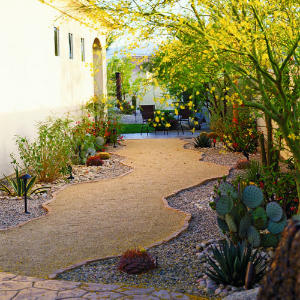
Decomposed granite can be used in different ways, even mixed with other substances. It is commonly used for sidewalks, gardens, pathways, patios, trails, playing fields, golf courses and any area where stone or aggregates can be used. You can also make decomposed granite driveways.


Decomposed granite is made of very small pieces of granite. The sizes can range from a maximum of 1/4" to a sandy consistency. It is a fairly fine mixture, as opposed to other materials.
DG can be used in a few different ways. How long it will last and the cost depends on which application is used for the project.
Decomposed granite can be used as singular material to create decks, driveways, and pathways. Decomposed granite can also be used in conjunction with other materials, such as flagstone, to economically create naturalistic hardscapes in your outdoor environment.


Decomposed Granite Selection

1.                 Choose decomposed granite for your project based on what you want the surface to look like. Decomposed granite selection ranges from ¼-inch pieces to pieces no bigger than grains of sand. The larger pieces can provide more surface texture to your pathway or drive where smaller pieces provide a smooth surface.

Pick the granite color best suited to your landscape and house colors. Just as granite counter tops come in a variety of colors, the small granite chips of decomposed granite come in similar color ranges. There are many shades of blues, greens, yellows and reds as well as natural stone colors. It is possible to use one color of decomposed granite for the main portion of the path and use a separate color as edging or accent.

You also need to decide how you plan to stabilize the decomposed granite. You can just pack the granite pieces tightly on the ground for a loose path or drive. Stabilizers are another option. These allow you to create a path that can last up to ten years and come already added to the granite. Adding resins to the decomposed granite allows you to set your driveway in place for up to fourteen years with a minimum of maintenance.


Decomposed Granite Preparation

2.                 Decomposed granite needs a solid bed to lie on. Preparation of the subsurface is important to the success of this project. Depending on whether this is a pathway or a driveway, you need to put down a bed of crushed rock. For a pathway, the rock needs to be at least four inches thick and a driveway needs a base at least six inches thick.

Before you lay the crushed rock, decide if you want the finished path or drive to be level with the ground's surface. If you do, you need to dig out enough dirt to allow that.

Put the crushed rock in place and wet it down. Run a compactor over the base to settle all the fine rocks into place and to provide a hard surface for the decomposed granite.

Decomposed Granite Installation

3.                 Place the decomposed granite over the crushed rock. Level it as much as you can by hand. Use a hose to water the decomposed granite down. This helps plain decomposed granite set up. The water activates the stabilizer or resin if you chose that type of application. Follow directions from your granite supplier for the proper amount of water to apply.

Once you can walk on the decomposed granite without sinking in or feeling muddy underfoot, use a roller to pack it down. Make several passes to ensure that the surface is smooth and has no marks from the roller.

Allow the decomposed granite to dry. Look for signs of chipping or cracking. You can repair problems with the addition of more water and decomposed granite. While the finished surface is solid, it's normal to hear the crunch of the rock in the sublayer.

      Contact me today for more information on how you can have a new decomposed granite deck, pathway or driveway in your landscape.

       Mark Taylor
       Cgreen Landscape and Irrigation
       We design, build and maintain your outdoor dreams.

Wednesday, January 5, 2011

Drainage Issues?......Ya Think!

Cgreen is an outdoor environment company.
That means we evaluate many different aspects of that environment as we plan your space.
Does your landscape company?
The above photo illustrates one of those critical aspects - drainage.

                                  With proper planning and with the right expertise Cgreen can anticipate and correct drainage issues on the properties we improve.In fact many realtors and property managers depend on Cgreen to evaluate proerties for drainage problems and to design and implement solutions to those problems. With Cgreen when we are done, nothing is left undone.